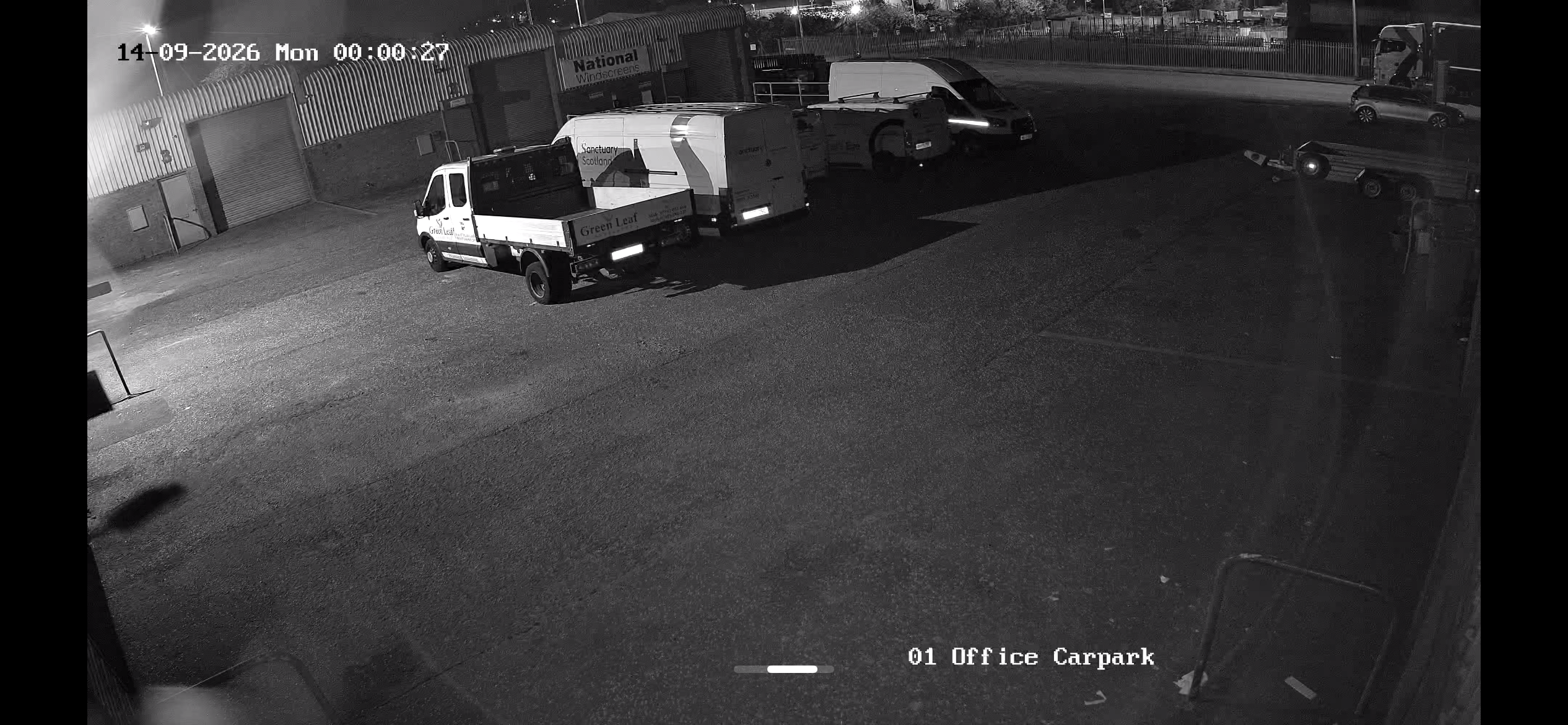
You can see the vehicles clearly enough, but you’d have no chance reading the registrations.
What CCTV can and can’t do with number plates
We get asked this one a lot. Can CCTV read number plates? The honest answer is sometimes.
If a car is fairly close, going slowly, coming at a decent angle and it’s broad daylight, an ordinary CCTV camera will often give you a registration you can read. The trouble is that “sometimes” isn’t much use if the registration is the one thing you need.
Why plates are harder than you’d think
A normal camera on a farm is usually covering a yard, an entrance or the front of a shed. It’s set up to give you a good picture of the whole scene, so you can see the vehicle, who got out of it and what they did. The number plate is a tiny part of that picture.
Then everything else is working against it. The vehicle’s moving. Plates are made to be reflective. The camera might be looking at it side on. And at night the headlights are pointing straight down the lens.
So you can have a perfectly good picture of a van in your yard and still not be able to read the plate.
Daylight is the easy bit
During the day, a decent camera in the right spot can do a surprisingly good job. Where people get caught out is assuming that because it read a plate at 2 in the afternoon, it’ll do the same at 2 in the morning.
It usually won’t.
At night the camera is trying to show you a dark yard with bright headlights in the middle of it. Either the plate ends up as a white blob, or there isn’t enough light or detail to make out the letters. The picture on this page is a good example. You can see the vehicles fine, but you’d have no chance with the registrations.
It’s not always hopeless though. We had one customer where a car came in at night, but the area was well lit, so the camera hadn’t switched over to night vision. We couldn’t get the full plate, but we got enough of it to pass to the police, and they were able to find the rest.
What a number plate camera does differently
A dedicated plate camera is set up for one job. It’s usually aimed at a narrow bit of the entrance that vehicles have to pass through, and it’s set to capture the plate rather than give you a nice-looking picture.
That means the footage can look a bit odd if you’re used to normal cameras. At night the rest of the picture might be almost black while the plate is perfectly clear. That’s not a fault – it’s doing exactly what it’s there for.
So we tend to treat it as two separate jobs. One camera shows you what happened and another one gets the registration.
Is that the same as ANPR?
People often use the two terms for the same thing, but they’re not quite the same (you’ll also see it called LPR, for licence plate reading). A plate camera just gives you a clear image of the registration that you can read when you go back through the footage. ANPR (automatic number plate recognition) goes a step further and reads the plate itself, so the system can log vehicles or let you search for a registration.
One of the handiest uses is with automatic gates. You can whitelist the plates you’re happy to let in, so the gate opens for them without anyone having to press a button. You can also blacklist plates you don’t want on site, so the gate stays shut for them.
Does every farm need one?
No. A plate camera costs more than a standard camera, and you usually end up needing two cameras, one to read the plate and another to give you the overview. So it’s worth thinking about what you’d actually use it for.
I’d be realistic about what a plate will tell you. A thief often won’t come in their own vehicle. We’ve had customers hit by people using false plates, by people in a stolen car with the plates covered up or taken off, and by people who parked off-site and just walked in. So for something like plant theft, a plate camera is less important than good coverage everywhere else. If it’s the diesel you’re worried about, there’s more on that in protecting a farm fuel tank.
Where it’s more useful is with the more opportunistic thief. That’s the one who comes in with a white van and takes advantage of there being nobody about.
It also makes a lot of sense anywhere with plenty of coming and going where you need to know which vehicle was which. That could be a site with lots of deliveries or visitors, a farm shop, an honesty box or a seasonal workers’ campsite. Customers have used ANPR at weighbridges to see exactly which lorry was weighed and when. Chicken sheds are another one, where you need a record of who’s been on site. We had one customer who needed to prove exactly which vehicle went down a particular road and when, as part of a dispute. Another customer’s robotic lawnmower was accidentally damaged by the postie, and their ANPR camera showed when and where it happened.
A word on data protection
If you’ve got cameras recording people, whether that’s their faces or their number plates, data protection rules apply. That’s true of ordinary farm CCTV as well, so it isn’t something that only comes up with plate cameras.
What’s different about reading plates, and ANPR especially, is that it’s treated as more intrusive, because you’re collecting a record of which vehicles came and went. It’s more of an issue again if the camera looks out over a public road rather than your own entrance.
None of that is usually a problem. It means putting signs up, pointing the camera at your own ground as much as you can, only keeping footage as long as you need it and being able to say why you’re collecting it. For ANPR you may also need to do a written assessment of the privacy impact before you switch it on. We’ll go through it with you when we survey the site.
So, can CCTV read number plates?
This is the bit that really matters. Before asking whether you need ANPR, think about what you’d actually want from the footage if something happened.
If you just need to know that a vehicle came in and what it looked like, a normal camera will probably do. If the registration could be the thing that matters, the system needs to be designed around getting it. That might mean a dedicated camera or moving one you’ve already got, or it might turn out the money’s better spent elsewhere on the farm.
f you’re not sure what you need at your own farm, give us a shout on 01382 217377. We’ll look at the entrance, the traffic that uses it and what you’d want to be able to see before we suggest any kit. Most of our work is farm CCTV and livestock cameras across Scotland, so we’ve seen a fair few farm entrances.
Chris Cotton runs Farmer’s Eye, an NSI Gold accredited security company in Dundee, and has been fitting CCTV on Scottish farms for over 15 years.